
Services
Regulation
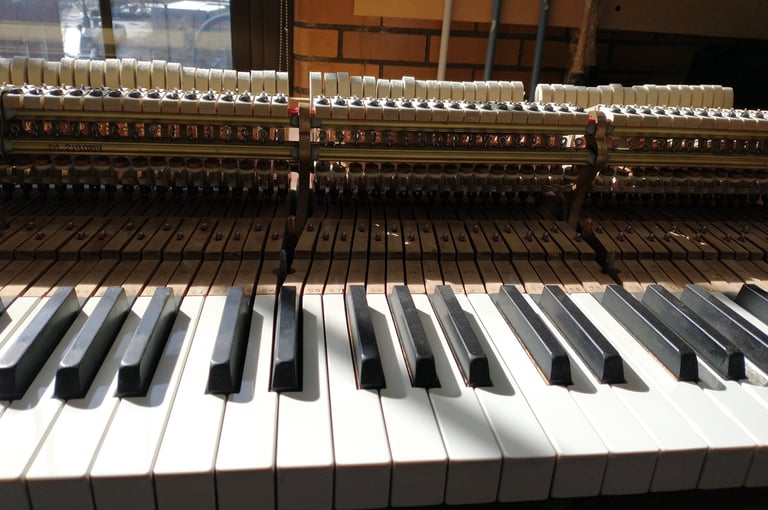
Regulation provides a pleasing and responsive touch to your piano keys and action through the fine adjustment of thousands of moving parts of wood, felt, and metal. Over time these parts shift, wear, and compress, and the piano starts to feel mushy, hard, or unresponsive. Having the piano regulated can restore the proper touch. A finely regulated action will be especially noticed and appreciated by a more advanced pianist trying to execute technically demanding music.
Repairs
Many small repairs can be done on-site, such as fixing or replacing broken parts, broken or missing strings, stuck keys, squeaky pedals, and more. Repairs that require more time or equipment can be done in my workshop. I love to fix things, so don't hesitate to ask!
Humidity Control Systems
Seasonal humidity change is the number one reason pianos go out of tune. Repeated wet/dry cycles also take a toll on almost every mechanical and structural part of a piano over time. I am a certified installer of Piano Life Saver systems which help stabilize the humidity around your piano, keeping the piano in tune longer and prolonging the instrument's life.
Tuning
Everyone who plays or hears the piano should experience the joy of a perfectly in-tune instrument. A piano has around 220 strings, each under an average tension of 160 pounds. A fine tuning consists of making extremely small adjustments to the tension of each string until they are all in relative harmony with one another.
Often, a piano will require one or more "rough" tunings (called pitch corrections) to bring it to the proper pitch before it can be fine tuned. Small pitch corrections are normal and expected with seasonal change, and are included in the cost of a fine tuning. Large pitch corrections tend to be needed when a piano has been allowed to fall out of tune over many years. If your piano requires a very large pitch correction, there may be an additional fee and/or a need for multiple tuning visits to bring it back to pitch.
Voicing
Cleaning
Electric Pianos
I have an interest in vintage electro-mechanical keyboard instruments such as Fender Rhodes, Wurlitzer electric pianos, etc. If you have one of these instruments that needs care, please get in touch with me to discuss.
Adjusting the tone (sound quality) of the piano, most commonly by altering the consistency of the hammer felt. Through voicing we can address issues of a piano's sound being too loud, soft, harsh, mellow, or uneven.
Inspection and Evaluation
Complete evaluation of a piano's current physical condition with a comprehensive written report. Useful before buying or selling a piano, or to get a sense of your current piano's care needs.
Professional cleaning of your piano, including the keys, action, key bed, soundboard, plate, pedals, and case. I offer a basic exterior cleaning of all areas you may see or touch, as well as a comprehensive cleaning which also includes interior mechanical areas of the piano.
"How often should I get my piano tuned?"
This is the most common question I get.
While there isn't a one-size-fits-all answer to this question, the best answer for most people is twice a year.
This schedule allows us to respond to New England's wild swings in humidity between summer and winter which knock even the heartiest pianos out of tune.
If your piano gets heavy use (e.g. you are a working musician or a piano teacher) or your ear is very sensitive to the tuning, you may choose to have even more frequent tunings. If you don't play much, are less sensitive to the sound of the tuning, or are on a tighter budget, once a year could be enough for you.
I don't recommend tuning less than once a year because pianos that aren't seen regularly by a technician can develop issues that will go unnoticed, and are likely to drift so far out of tune that they will have a more difficult time being brought back into good playing condition.


Here is a list of my most common services. For other inquiries, please contact me.
For my rates, please visit my online scheduler (click the button above) or contact me.
Restoration and Rebuilding
Services may include restringing, action restoration or complete action rebuilding, and more. For fine quality instruments whose performance has declined with age or use, an investment in restoration or rebuilding can bring back the beauty of which these instruments are still capable.
daniel@levpiano.com
(413) 834-2735
© 2026 All rights reserved.


Daniel Lev, RPT